Thursday, March 24, 2011

Voluntourism: Is it helping them or you?

As of late I've been contemplating the issues surrounding tourism and volunteering and the issue of responsible tourism.

I hear from and meet a lot of travelers who pass through Siem Reap in my role as the founder and lead moderator of the Siem Reap-Angkor group on CouchSurfing. Many are here only for a few days, while others stay slightly longer.

It's only a few who actually choose to stay in Cambodia for at least a month. Many of these folks often look for places to volunteer. And most of these volunteer-seekers think the only alternative is going to an "orphanage" to play with or teach children. They have no idea about where to begin and often look for recommendations of places to contact.

My first recommendation for these volunteer-seekers is to visit the ConCERT Cambodia website. ConCERT describes itself in the following way on its homepage:
ConCERT – "Connecting Communities, Environment & Responsible Tourism" - is a non profit organisation based in Siem Reap, Cambodia. Our aim is to reduce poverty, and we do this by bringing together people who want to help, and local organisations that need the kind of support they can give.

At ConCERT we have information on a range of organisations that are engaged in humanitarian activities, all of whom need your support. They are wellmanaged and financially transparent, and work in partnership with local people.

We also have a wealth of information on the causes and effects of poverty in Cambodia; this information explains why there is such an urgent need for your support.

At the ConCERT office in the centre of Siem Reap we have information on a range of organisations engaged in community development and support activities, and which supplement the work of the government.
What I really LOVE about ConCERT is that its founder, Michael, has made a huge effort in checking out numerous local organizations and charities within Siem Reap.
All our member organisations need your support and are well managed, financially transparent, and work in partnership with local people. Every organisation is different and requires different types of help. All our member organisations need your support and are well managed, financially transparent, and work in partnership with local people. Every organisation is different and requires different types of help.
Being a teacher for a hotel and tourism school, I feel it is even more important to be "in the know" so that I can be a responsible teacher. After all, it's these same tourists who they will depend on for their jobs once they finish their training.

I've also been reading posts from Daniela Papi on her Lessons I Learned blog, and have been both empowered and dismayed. There is a lot of dialog going on, but the key point I keep hearing repeated is that there is a need for more transparency and willingness to share. Sharing can take the form of ideas, lessons learned or even just simply talking things out in the open.

I am empowered to provide the most accurate information about volunteering and speak out as much as possible about making well thought out choices for how to support the work happening in Cambodia. I do this by posting as much information I can and directing people that I meet to places like ConCERT.

At the same time, it is disheartening to encounter the numerous well-intentioned people who are seeking "easy" ways to volunteer and "help" the poor in Cambodia, while ignoring what would and should be good practices in their home countries simply because "this is Cambodia."

Somehow, these seemingly well-educated people think it is OK to disregard safe and responsible practices. They leave their logic at the door because to them, any help is better than no help in a developing country like Cambodia.

Why should it be acceptable to just walk in to any village, school or children's center and just start "volunteering"?

When I read articles like this one, "UNICEF Concern Prompts Cambodian Investigation of Orphanages," it makes me wonder what it's going to take to get tourists to change their perception of volunteering. Part of the responsibility lays in the hands of the tour agents and operators. While the other half is tourists themselves who need to start re-adjusting their thoughts as to the wider impacts of such short-term volunteering on the local population who must put up with the revolving door of volunteers.

It's going to take a paradigm shift for both tourists and tour operations in order to adjust their view of "voluntourism," which has become the de facto model for "helping" the poor and less fortunate, particularly in Cambodia.

Daniela Papi has provided some excellent links that I have found extremely useful in framing my position on this issue.

Where do we draw then line when good intentions for the sake of doing good is not enough?

How to evaluate an orphanage, by Saundra Schimmelpfennig

Before you pay to volunteer abroad, think of the harm you might do, by Ian Birrell (despite this article, tourist STILL think it's perfectly OK to walk into orphanages for dance shows, buy for child sellers, or give money handouts to beggars.)

Cambodian Orphanage Tourism, on Aljezeera

Orphanage Tourism: The Catch-22 of Orphanage Funding, by Eric Lewis

Orphanage Tourism in Cambodia: Good Intentions are Not Enough, by Saundra Schimmelpfennig

A Protest Against Orphanage Tourism, and other orphanage tourism related posts on this blog

Sasha Dichter of Acumen Fund reminds us to be generous and use our heart, but to “ask the tough questions”

Here's my own useful link for some really useful ways for giving back and helping back without mucking about in the lives of people where the author provides 8 rules for “econ-travel.” Is There a Right Way to Spend Money When Traveling?

Thursday, March 10, 2011

Is There a Right Way to Spend Money When Traveling?

I ran across this article from the New York Times through a CouchSurfing friend who posted it on Facebook. Some of the more interesting points involve the author's rules for "econ-travel."

Is there a “right” way to spend, tip and give money when traveling?

The idea of “responsible tourism” has taken hold in recent years, largely in the guise of eco-travel, in which environmental factors become central. But one stumbles into many other ethical issues when traveling. One of the most unavoidable — especially when in the developing world — is how to help.

But what if you travel on your own? Are there ways to make your spending matter? How much should we tip the bellhop? How aggressively to bargain? When to give to panhandlers?

Repeatedly confounded by these questions, my wife, Joan, and I started to compile an informal rule book for what we call “econ-travel.”

1. Fix a daily or weekly budget.

2. Overbuy gifts for yourself and others. “Crafts are the best thing to buy; they have people’s dreams woven into them.”

3. Don’t bargain down price, bargain up quantity. Too many people want the cheapest price regardless of the seller's income potential. Bargain according to what you think is fair, but is also a win-win for both you and the seller.

4. Try to be more than a consumer. Local citizens “may be economically poor but they are often culturally rich,” says Harold Goodwin, professor of Responsible Tourism Management at Leeds Metropolitan University in England. So, engage in their culture by getting off the large bus and taking an interest in how they make their living. . .The rule is simple, Mr. Goodwin says: “Treat them as you would like to be treated.”

5. Let others earn a living by helping. I’ve learned to relax and let someone else carry my suitcase. It’s a rational way for local residents to feed their families, and certain people have turned luggage-carrying into an art.

6. Don’t give to panhandlers. Handouts send a multitude of wrong messages about dependency and the value of work. Plus, handouts encourage more begging, often by children (an awful alternative to school). Long-term change never starts with a quarter or even $10 stuck into someone else’s palm.

7. Instead, buy stuff on the street. The hawker’s life is a tough one, always a fight against weather, traffic and crime. So if you want to help, buy more than you usually might. . . Why not bolster that small-business spirit?

8. Sample local food. Tourists in the developing world often eat at a limited number of hotels or restaurants deemed safe by guidebooks. There’s logic to that, especially where food-borne illness is concerned. But you’d be missing out on part of the reason you travel in the first place.

“Buy food and beverages from local producers, taste the locally produced foods and enjoy this as part of your holiday experience,” Mr. Goodwin says. For instance, you haven’t really tasted a banana if you’ve never had one grown for immediate consumption (compared with ones modified for export and sold blemish-free in United States supermarkets). Peels help keep the fruit safe, as does boiling in the case of a cup of local tea. The winners are the farmers, who often are at the bottom of the economic pyramid.

My favorite quote from Rule #2 is, “Crafts are the best thing to buy; they have people’s dreams woven into them.”


I'm also personally fond of Rule #3 since I encounter numerous travelers who are only interested in the cheapest prices without considering who their stinginess is really affecting. It makes me rather sick when I hear behavior like this.

Sunday, February 13, 2011

Cooking in Cambodia

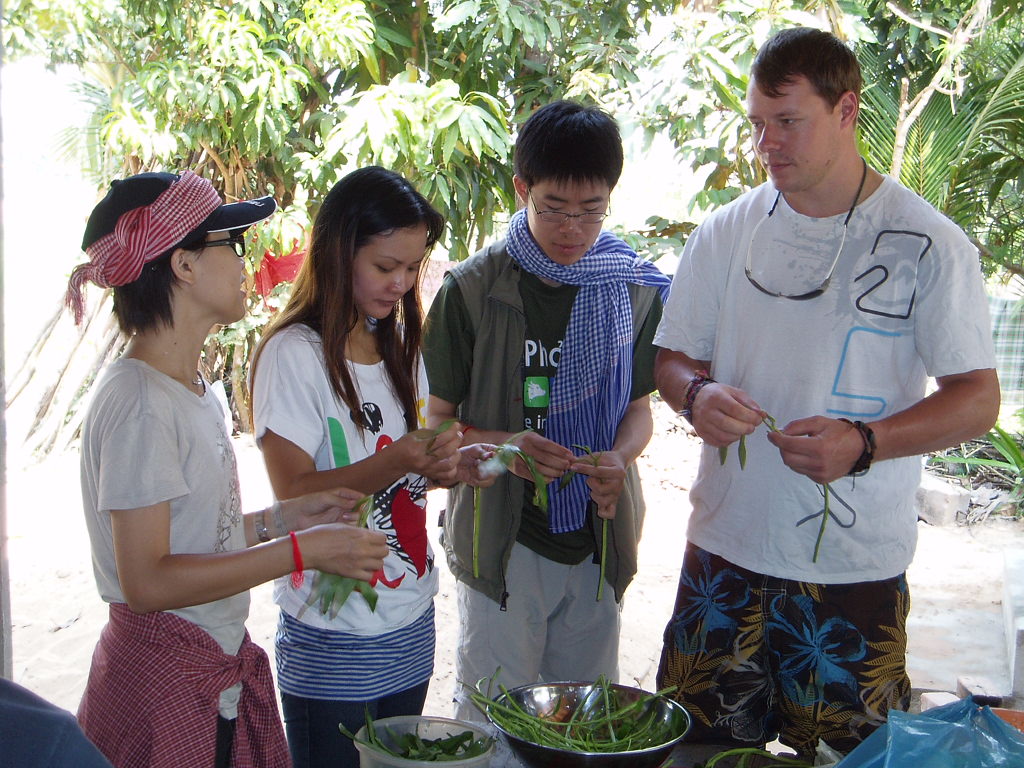
Angela from Vietnam, Theresa from Indonesia, Elliot from California and Adam from Texas

I spent last Monday out in the village for a cooking class put on for my CouchSurfing friends. Da and I had planned a pretty hefty menu of 4 courses including:
  • Fried Spring Rolls
  • Samlor Majou Groen (sour soup with beef and morning glory water spinach)
  • Beef Lok Lak
  • Pumpkin Custard
The steamed pumpkin custard. Yum!

Five Couch Surfers participated, though some were a bit more active than others. There was a lot of garlic that needed to be peeled! I hopped on that one right away.

Angela giving the beef a stir.

Da's brother Houy just so happened to be up visiting from Phnom Penh, so he helped with the explanation of things, too.

Houy helps out and keeps things organized!

We ended up eating the spring rolls after the soup and Lok Lak. I would have rather not used dried shrimp in the spring rolls, but that's what his mom decided to use.

Wrapping the spring rolls.

Here's a video link showing the beef Lok Lak being cooked.

What a fun day!

Saturday, February 05, 2011

Rubbing me the wrong way

Getting a massage in Cambodia is commonplace. Some even come with happy endings (at least ones that are offered to men). I generally don't get massages because I don't really like the idea of someone I don't know putting their hands all over me.

But, worse than that, I haven't really ever had a great massage.

I remember one time I got a massage where I felt worse coming out than when I went in. I felt like I was beaten and bruised during the whole ordeal.

I sincerely believe Cambodians don't really understand how to massage a foreigner. Either you're being pounded and stretched like you're on a medieval torture device, or they just push some skin around and snap your fingers.

Tonight I had another disappointing massage.

I was really expecting something better because it was a friend's place, and he had really talked it up as being great. In the end, nothing was really massaged. I just had some fat pushed around, not my shoulders and feet worked on like I was hoping.

Oh well, I guess I'll keep looking and hoping...

Tuesday, January 25, 2011

Another amazing organization in Siem Reap

I was first introduced to the young man who helps run the Khmer for Khmer Organization (KFKO) through a CouchSurfing contact. After arranging a meeting with Sokha, he introduced me to another friend from France, Raphael, who was helping out, too. I ended up making a plan to ride our bikes out to visit the village where KFKO does their work.


KFKO is truly doing what it's name implies. Cambodians are helping Cambodians. The young volunteers are using their own money, in addition to the occasional donations, to fund four major projects within the village.


KFKO focuses on Early Childhood Education, Nutrition for Mothers & Children, a Handicrafts project for HIV-positive women and an Agricultural project for growing vegetables to help out the nutrition program and villagers who participate.


Only founded in November 2010, these young folks have big dreams for this village.

Pancakes

Thank you to Mom Most Traveled, Can Can, for providing this recipe. I look forward to trying this out with a few modifications for here in Cambodia, such as substituting soy milk for rice milk, using regular oil, and adding bananas instead of blueberries and walnuts.

Ingredients

Wet Ingredients (have at room temperature):
2 eggs
1/4 cup rice milk
2 Tbsp oil (walnut, almond, grapeseed or corn)
1/2 tsp vanilla (optional)

Dry Ingredients (have at room temperature):
3/4 cup rice flour (or 1/2 cup rice flour and 1/4 cup corn flour)
3/4 tsp non-aluminum baking powder
1/2 tsp salt
1 or 2 Tbsp oil for frying (coconut or corn)
1/8-1/4 cup blueberries fresh or frozen
1/8 cup walnuts (optional)

Directions

Mix wet and dry ingredients separately, then combine. Be sure to have the griddle heating to a medium temperature. Blend in blueberries and walnuts if used. Makes about 5 five inch cakes. Smother in maple syrup.

If using fruit in the batter, covering the cakes when cooking helps ensure they will be done throughout. A little more baking powder makes for thicker, fluffier cakes, and a little less makes thinner more dense cakes.

Monday, January 24, 2011

Compassion in action

My first week of travels back to Southeast Asia in early December 2010, took me to Thailand. I spent a couple of days in Bangkok before heading up to Chiang Mai that would serve as my base for a 1-day visit to the north in Fang to visit the Compassion child I sponsor: Jairak Ja-U.
Our 1st meeting. Me holding the traditional bag his mother made for me.

I really didn't know what to expect since I had only just started sponsoring Jairak Ja-U a couple of months prior. The two other children I was sponsoring had both dropped out of the program within a month of each other, and Jairak was the recommended boy to replace them.

He couldn't have been a better match!

Posing in front of the "Christmas flowers" (Poinsettias).

The shyness was very evident, yet understandable. We exchanged gifts and asked a few questions (translated, of course) before getting a tour of the hostel where he is living. He seemed very happy to have met me. It was very special since many children don't ever get to meet their sponsors except through letters and photographs.

I think the best part of the trip was going to his high school to see his classroom and his best friends. It was a pleasure to be able to meet them and pray together before saying good bye.
Standing with his school mates & friends.

I will cherish that day, despite feeling a little under the weather in the morning. It was so adorable when we said goodbye as Jairak called out, "Good bye. See you tomorrow!" in English.

Precious.
Visiting the local hot springs in our matching hats (which we both like to wear).

Sunday, January 23, 2011

Self-Analysis

I'm an ideas person, for the most part. But, I'm also a doer, but more in the sense of a "following orders" kind of way, rather than a "rally the troops" leader. I have a really hard time transforming my ideas into action.

But I have these grand ideas!

What am I missing? Am I my own stumbling block?

More than likely, yes. I like to think that I'm missing a team. I need my go-to person who can put wheels to my ideas.

I can organize, coordinate, plan, create, you name it, but when it comes to taking it one step beyond I stumble.

I've got lots of knowledge of how to do things, and am very capable at doing A LOT of different things, yet I feel somewhat stuck.

Maybe I need one of those Life Coaches...

Wednesday, January 19, 2011

Some Amazing Activities in Siem Reap, Cambodia

In the short time that I've been back, I have encountered or read about a few incredible organizations that are doing amazing stuff. They're working on projects that inspire me!


Check 'em out!
We are MaD Cambodia – a registered Cambodian Charity/NGO working to make a difference for good in Siem Reap, Cambodia.

Working in partnership with rural Cambodian communities, our aim is to empower individuals, families and villages with the knowledge and resources they need to build themselves a sustainable future free from poverty. Through our Rural Community Development and Children’s Welfare Programs, we offer Cambodian communities assistance in areas such as water, sanitation, housing, construction, sustainable agriculture, healthcare, childcare, orphan care and education.

MaD is a Cambodian charity/NGO – 100% non profit – set up to help the Cambodian people. If you are visiting Siem Reap City, Cambodia and would like to have a meal with us at Me - Cambodia's first donation only restaurant or learn more about our charity, projects or donating, then please contact us.

At PEPY, we want to live in a world where everyone has access to quality education, increased health and environmental awareness. Through our programs in Cambodia, we are committed to making improvements in education, the environment, and health by investing in a local team of dedicated leaders and connecting them with the tools to help deliver the changes they want to see in the world.

If you too believe that education is the key to change in the world, why don't you join us!

PEPY's mission is to aid rural communities in improving their own standards of living, with a focus on increased access to quality education. Through our partner government schools, and our informal education initiatives, PEPY is supporting education for over 1,700 families in 12 villages and 6 schools in rural Siem Reap. We believe that education is the key to sustainable change, and are committed to a holistic developmental approach which empowers children, parents, teachers, and communities to make the positive changes they want to see in their lives.

To find out more about PEPY and what we do, read the "What is PEPY?" section of our site.

PEPY is a non-governmental organization registered in both the US and Cambodia.


Saturday, January 15, 2011

New Year, New Wheels

Ready to hit the roads and kick up some dust.

New Year 2011! I started with a bicycle and have upgraded.

I've entered the world of two-wheeled motoring by purchasing the above motorbike. It's a Honda Super Cub with a 70 or 90cc size engine. It came newly painted in the bright orange and green colors, along with the red mirrors. The shop owner put on the front basket, which I use all the time! The bike is a kick-start, and needs some time to warm up in the morning or after it's been sitting.

I bought it on a Monday out of necessity to get to the school where I teach, which is quite far down the road (about 5km or more) to ride a bicycle in the hot sun. Plus some nights I have to get to my volunteer job within 3o minutes during rush hour, so a bicycle wouldn't do, nor would hiring a driver.

Then Thursday started with a flat tire that required a complete inner tube change, and the fun didn't end there. I arrived late to work, and as soon as I pulled into the driveway, my front wheel seized up. Ack! Thankfully I wasn't in the middle of traffic. Some folks from the school helped take care of my bike while I went to my class.

She's a beauty! All I can think of is mangoes when I see it.

But, it didn't end there...When trying to leave school, my front wheel did the same thing. So we packed it up in a tuk tuk and took it back the shop. It was closed, but fortunately one of the guys was still there and he was able to come out and work on my wheel again. Back to the road.

I went out to dinner to relax from the long day and on the way home while trying to stop to buy some fruit, my wheel seized for a third time! What is going on!?! I tried calling anyone I knew who might be able to bring a tuk tuk to haul my bike back home again. I was only minutes from my house. Thankfully one of the drivers from the guesthouse of the organization I volunteer for was able to come and he managed to help find a way to get it moving again.

I limped home and went to bed. I wouldn't drive my motorbike on Friday. I left a note for Da to inform him of what happened and what time I finished school that day. Thankfully he got it and was there to pick me up from school. Because I had forgotten to leave the key, he didn't have a chance to check out the bike until I got home.

Da checked out the bike and gave it his seal of approval, so I drove it, though nervously. His diagnosis: don't use the front handbrake. I ended up taking it back to the shop on Saturday to have it checked out. Plus, the headlight had gone out on Thursday night and I didn't want to keep driving at night without a headlight.

Now I'm back on two motorized wheels again. All's well with the motorbike. It hums along just fine. The front handbrake works, though I'm not eager to use it. It's all in the right foot, folks!

My dad would have loved this little "scooter" with its round tail lights, his favorite style.

Saturday, January 01, 2011

Happy New Year


My first lunch box was a metal Peanuts lunch box. I loved that lunch box. I have fond memories of Charlie Brown and the Gang. Despite having over-sized heads and honking grown-ups that you never saw, these kids had

Tuesday, December 28, 2010

‘Regret’ over forced evictions

I find this slight humorous, if not a Homer Simpson "Doh!" moment. To think that the government ministers are now claiming ignorance of humanitarian policies is certainly a bit far-fetched, but I suppose acknowledging it is the first step. Let's hope that this is a positive sign for future development policies of the Cambodian government.


Monday, 27 December 2010
By May Titthara

A senior government official yesterday expressed “regret” over the forced eviction and relocation of thousands of Phnom Penh residents in recent years, attributing problems to a lack of awareness in resolving government policy.

Speaking at a workshop in Phnom Penh yesterday, Im Chhun Lim, the Minister of Land Management, Urban Planning and Construction, said that though the removal and relocation of residents’ homes was commonplace in developing countries, it was important that the government takes action based on the proper policies.

He said much confusion stemmed from residents who are living illegally on state land, but who claim ownership and market-price compensation for their properties.

“It is regrettable that [we] were not previously sufficiently aware of how to resolve issues such as the confusion between resettlement based on humanitarian policies and the resettlement based on market price compensation or unreasonably high compensation demands that could not be accommodated,” he said.

Im Chhun Lim added that some relocation cases were complicated by the involvement of politicians, which delayed compensation negotiations or caused standoffs between residents and the authorities. Often, the disputes did not end until the government took “administrative measures”, forcibly removing residents from disputed land.

He stressed that the government wanted to avoid these problems at all costs, and would implement a “humanitarian” policy related to urban evictions and relocations.

Back in Cambodia

view from my balcony with Angkor Wat on the horizon (if you squint or have binoculars)

Aaahhh...I'm baaack!

It's great to be back in Cambo-land. I've got a nice flat to live in with Wi-Fi and enough space, even though it's a little further than I wanted from the main part of town and I have to fight traffic by the big market every time I come and go.

Getting settled in and re-connected with folks has been good. I managed to find a part-time paying job within 3 days of arrival thanks to a CouchSurfing connection. And, the funny thing is that it is a school I taught at 5 years ago, Paul Dubrule Hotel and Tourism School. And there are a few more things in the pipeline.

Now I'm in my final week of "freedom" before the volunteering and teaching begin on January 3rd.

Monday, November 29, 2010

Hundreds die in tragic end to water festival

I haven't had a chance to post on this, even though it happened one week ago today. It is most definitely a tragedy that could have been avoided. The loss is incredible and heart-wrenching. This is one reason why I have steered clear of Phnom Penh during its annual water festival. One's safety just simply cannot be guaranteed.

Here are several links to articles printed in the Phnom Penh Post about this incident.

Stampede in Cambodia kills hundreds, government says
By the CNN Wire Staff
November 22, 2010

A stampede that occurred during a festival in Cambodia's capital city of Phnom Penh has killed 339 people, officials said Monday.

Another 329 people were injured in the crush, said Philip Bader, a news editor with the Phnom Penh Post, citing information given by Prime Minister Hun Sen in a televised address.

Visalsok Nou, a Cambodian Embassy official in Washington, said more than 4 million people were attending the Water Festival when the stampede occurred.

But other reports put the number at 2 million., said Steve Finch, a journalist with the Phnom Penh Post.

The municipal police chief said that the stampede, which began around 10 p.m. (10 a.m. ET), likely occurred because a suspension bridge packed with people began to sway, creating panic, said Bader, who cited reports of people jumping from the bridge into the river below.

Finch said police began firing water cannon onto a bridge to an island in the center of a river in an effort to get them to continue moving across the bridge.

"That just caused complete and utter panic," he told CNN in a telephone interview. He said a number of people lost consciousness and fell into the water; some may have been electrocuted, he said. Finch cited witnesses as saying that the bridge was festooned with electric lights, which may have played a role in the electrocutions.

The government denied anyone was electrocuted.

Video link to report on stampede.

Hundreds die in tragic end to water festival
Tuesday, 23 November 2010
Post Staff

Hundreds died and hundreds more were injured last night in a stampede on Diamond Island’s north bridge, bringing a tragic close to the final day of water festival celebrations in Phnom Penh.
Prime Minister Hun Sen announced via video conference at 2:30am that 339 people had been confirmed dead and 329 injured.

“With this miserable event, I would like to share my condolences with my compatriots and the family members of the victims,” he said. “This needs to be investigated more.”

This is the biggest tragedy since the Pol Pot regime,” he said, adding that Cambodia would hold a national day of mourning on Thursday and that a committee would be set up to investigate the incident.

The cause of the stampede has not yet been confirmed, but Minister of Information Khieu Kanharith said it happened because “one million people”, many of whom were leaving the island, became “scared of something.”

Phnom Penh struggles to cope with tragic stampede
Tuesday, 23 November 2010
POST STAFF

Cambodian officials today were struggling to cope with the aftermath of last night’s tragic stampede on Diamond Island in Phnom Penh that left more than 300 people dead and several hundreds more injured.

Prime Minister Hun Sen announced early this morning via video conference that 339 were confirmed dead.

Nhim Vanda, deputy director of the Department of Disaster Management put the figure today at 349, while unconfirmed reports from police officials said 375 had been killed.

Death toll surges in island disaster
Wednesday, 24 November 2010
By Cheang Sokha

The death toll from Monday’s tragic bridge stampede has leapt to 456, according to official figures released yesterday, eclipsing earlier estimates that put the number of dead at around 350.

In a statement announcing the figures, Ith Sam Heng, Minister of Social Affairs and the chairman of the government’s committee investigating the cause of the incident, stated that the toll spiked after 17 provinces reported their casualty numbers to the authorities.

“After each province reported to the subcommittee, the total number is 456 now,” said Ith Samheng.

“Some bodies were transported home straight away and some injured people died at home,” he said, explaining the increased toll. “This is a shocking incident for Cambodia.”

Hundreds of people were crushed and suffocated to death on Monday night when crowds attending the annual Water Festival became trapped on a narrow suspension bridge, in one of the country’s worst peacetime losses of life.

Cambodians turn out to honor the dead
By CNN Wire Staff
November 25, 2010

Hundreds of somber-faced Cambodians assembled Thursday morning in front of the suspension bridge in the capital where hundreds of people died Monday in a stampede during a festival.

Some carried flowers, others lit candles and incense in honor of the dead in the ceremony early Thursday, which the government has declared a day of mourning.

PM overcome by grief
Thursday, 25 November 2010
Cheang Sokha

CAMBODIANS across the country observed a day of mourning yesterday for the victims of Monday’s Diamond Island stampede, as questions remained about the ultimate cause of and responsibility for the disaster.

Government officials said Wednesday that the death toll had reached 456, though that number was revised downward yesterday to 347. Senior Minister Om Yentieng, the deputy chairman of the government commission investigating the incident, said yesterday that the death toll provided a day earlier by the investigatory sub-commission had double-counted victims who were brought to local hospitals before being returned to their home provinces.

Government officials gathered yesterday morning at the site of the tragedy, where Prime Minister Hun Sen shed tears as he knelt to pay respect to the souls of the deceased.

Tragedy a ‘joint mistake’
Monday, 29 November 2010
Cheang Sokha

Government authorities have announced the conclusion of their investigation into the causes of last week’s lethal stampede on Diamond Island, saying no officials will be held to account for an incident that was described as a “joint mistake”.

Announcing the results of the inquiry, Deputy Prime Minister Sok An backed up preliminary findings that the incident was triggered by mass panic related to the swaying of the bridge leading to the island.

“There is no sign of terrorism or that criminals arranged this in advance. We can say that it was caused by a stampede,” said Sok An, who headed the committee investigating the Diamond Island tragedy.

Sunday, November 14, 2010

Bloggers United Challenge: Week 3

The Challenge

What's inside your handbag? You can tell a lot about a person by what they carry around with them everyday. What's in yours and why? (photos are always welcome)

I once sat next to a man who exclaimed, "Wow! You have such a small purse!" This is true. I don't like to carry around big bags and have them filled with everything under the sun. Generally my purse has the basics. This is what's currently in my purse:
  • a small zippered wallet with card slot because a larger wallet is just too cumbersome
  • 2 pens (free from an agricultural company) that write fantastically
  • 1 mechanical pencil (from where I'm working) because you never know when you need to write in pencil
  • sunglasses in their soft case are a must for going out into the sun and driving
  • car & house keys
  • a small zippered bag that contains chapstick, gum, toothpicks, tissues, lotion, nail file and eye drops; one must always be prepared.
  • a notepad to write down my thoughts, reminders and other lists
  • a few coupons for local restaurants
  • a Tupperware container with chili & lime almonds and a another with chocolate almonds because I like to make sure I have snacks
  • my cell phone (on vibrate), otherwise it's in my pocket
  • a few postcards to write out and send for Swap-Bot swaps
  • my friend's newsletter from China for me to read while I'm waiting for something. It's 11, single-spaced pages long!

Friday, November 12, 2010

Bloggers United: November Challenge Week 2

Challenge


Oh dear! You're on death row! (don't worry....... you're totally not guilty and the governor is going to call to stop it before it happens). What is your last ever meal and why?


I would ask for a roasted turkey dinner with all the trimmings that was prepared by my mom:


  • cornbread stuffing

  • honey cinnamon yams

  • mashed potatoes & gravy

  • homemade dinner rolls

  • broccoli & cauliflower with melted cheese

  • pumpkin pie

  • apple pie

There's not much better than that, except maybe really good chocolate mousse.


If she's not availabe to cook a turkey dinner, I'd ask for BBQ'd chicken from F. McLintock's in Shell Beach, California. The local saloon in my town offers a Tuesday special of a 1/2 chicken with your choice of BBQ or pineapple sauce with cheese bread and your choice of fries or a baked potatoe. The dinner used to come with their famous ranch beans and a side salad, but now that's extra.


Dessert would have to be either Doc Burnstein's ice cream (which is a reincarnation of the original Burnadoz Ice Cream Parlor) for a drumstick, or a pink champagne cake from Madonna Inn.

Wednesday, November 10, 2010

Tight leash for monks

This article reminds me of the time I was studying the Cambodian language under the tutelage of 3 young Cambodian monks in 2004. I discovered that monks are the same as any young boy in his teens, hormones and all. They kept a pair of binoculars to watch any young girls who came into the pagoda compound.

In addition to that, I actually had a monk fall in love with me, sending me frequent emails describing how he wanted to hold my hand and such. And this was after only meeting him once. I have to laugh a little at the thought of the monks being told to watch the boat races from a "safe distance" to keep them in line with Buddhist precepts.

Monks line up in front of Angkor Wat during a Visak Bochea Day ceremony in April. Photo by: Sovan Philong

Wednesday, 10 November 2010

By Vong Sokheng

Buddhist monks will be allowed to watch boat races during the upcoming water festival – but only from a safe distance.

The Ministry of Cults and Religions says it has banned Buddhist monks from walking freely among the crowd during the three-day festival, which runs from November 20-22, in order to preserve proper Buddhist morality.

“We are not prohibiting the Buddhist monks from taking part during the festival if the monks will gather and sit in one place that is not too close to the crowd,” said Dork Narin, secretary of state at the ministry.

“In order to keep monks in [line with] good Buddhist concepts and to keep a neutral mind, we will not allow the monks to walk freely in the crowd because the monks could break the rules if they see a sexy lady or a couple kissing in the crowd.”

Monks are expected to remain celibate, refrain from touching or being alone with women and are forbidden to drink alcohol.

At least 20 Buddhist monks were disciplined at last year’s water festival for allegedly walking amongst the crowd and flirting with girls, said Ten Borana, personal assistant to the Kingdom’s chief Buddhist monk Non Nget.

Tuesday, November 09, 2010

Cambodian sanitation ranks last in region

This is why I am so excited about furthering the Sustainable Sanitation Cambodia project. Cambodia ranks the lowest in Southeast Asia in its access to toilets. Let's build some toilets in the Cambodian countryside people!

Tuesday, 09 November 2010
By Rann Reuy

Fewer people in Cambodia have access to adequate sanitation facilities than in any other Southeast Asian country, according to a new report from the Ministry of Rural Development.
Only 29 percent of Cambodians had access to sanitation facilities as of 2008, said the report released on Monday, which draws on figures from the World Health Organisation and the UNICEF Joint Monitoring Programme for Water Supply and Sanitation.

By comparison, 96 percent of people in Thailand, 75 percent in Vietnam and 53 percent in Laos had access to such facilities, according to the JMP 2010 report, which was released in March.
Furthermore, 67 percent of Cambodians living in urban areas had access to sanitation facilities in 2008, compared with only 18 percent of people in rural areas.

Chea Samnang, director of the Rural Development Ministry’s Department of Rural Heath, said on Monday that the number of toilets in the Kingdom’s rural areas was increasing at about 2 percent annually.

“We see it is increasing, but it is so slow,” he said.

He said he did not believe that the lack of progress in rural areas could be attributed to poverty levels, arguing that many people who did not own a toilet, which would cost about US$20-30, owned other “modern electrical items” such as motorbikes or telephones.

They Chanto, hygiene promotion officer at the ministry’s Rural Hygiene Education Office, said a substantial number of Cambodians defecate in the open, meaning that about “3,000 fresh stools were scattered into the environment each day”.

Thursday, November 04, 2010

Ideas worth reading about

Check out these ideas and links very thoroughly. They are worthwhile and demonstrate how the simplest idea can be transformative. It's an encouragement for me to move beyond my ideas and push them into reality.

D.I.Y. Foreign-Aid Revolution by Nicholas D. Kristof, a New York Times Op-Ed columnist.
I became interested in such figures while writing a book with my wife, Sheryl WuDunn, about educating and empowering women as a solution to many of the world’s problems. We ran into extraordinary men, like Muhammad Yunus of Grameen Bank, who pioneered microfinance in Bangladesh. Or Bill Drayton, an American who is a godfather of entrepreneurs working for social change and who now runs a group called Ashoka to support them. Or Greg Mortenson, whose struggles to build schools in Pakistan and Afghanistan are chronicled in “Three Cups of Tea.” But it struck us that women in particular were finding creative ways to help the world’s most vulnerable people, many of them also women.

How to Change the World from Nicholas D. Kristof's "On the Ground" blog.
First, dip your toe in the waters to get a sense of the work that is being done and to find what resonates most with you. Another approach is to browse a comprehensive site like Global Giving, where organizations around the world have posted their wish lists. Another easy first step is to sponsor someone abroad through a program that lets you contribute a certain amount each month to that person and exchange letters.

Meanwhile, keep an eye out for a cause and organization that particularly speaks to you, that exhilarates you. Then dive in and focus your efforts on that organization. Also, don’t limit your involvement to writing checks. People are also needed to sign petitions and write indignant letters to members of Congress. Try to visit a project that you’ve supported. This doesn’t work for everybody, but think about volunteering for a stint abroad. Or there are many other organizations that will take volunteers to teach English or do other work, and it truly can be a life-changing experience.

I also recommend the books by David Bornstein on social entrepreneurship. His best known is “How to Change the World,” which has become the bible of would be change-makers. There is also a list of recommended organizations by Kristof.

Finding Volunteer Trips that Actually Help. By Marnie Hunter, CNN.
The idea of volunteering away from home seems like a win-win to many travelers: a way to experience and help another community at the same time. But without a solid, well-designed program and reasonable expectations, volunteer travel can do more harm than good.

Showing up in parts unknown, hoping to make a big difference in a small amount of time, is likely to leave travelers and hosts disappointed.

"You're not going to change the world in a week or two. You're not going to eradicate poverty in a village. You're not going to teach a kid how to read," said Doug Cutchins, a former Peace Corps volunteer and co-author of "Volunteer Vacations: Short-term Adventures That Will Benefit You and Others."

The key to having a positive impact in a short amount of time is realizing that your efforts are part of a process, Cutchins said. Results are subtle and come about slowly through a long line of volunteers.

ConCERT Cambodia. ConCERT – "Connecting Communities, Environment & Responsible Tourism" - is a non profit organisation based in Siem Reap, Cambodia. Our aim is to reduce poverty, and we do this by bringing together people who want to help, and local organisations that need the kind of support they can give.

At ConCERT we have information on a range of organisations that are engaged in humanitarian activities, all of whom need your support. They are well managed and financially transparent, and work in partnership with local people.
We also have a wealth of information on the causes and effects of poverty in Cambodia; this information explains why there is such an urgent need for your support.

Global Giving. The world is full of problems. GlobalGiving is full of solutions. GlobalGiving connects you to the causes and countries you care about. You select projects you want to support, make a tax-deductible contribution, and get regular progress updates - so you can see how your gift is making a difference.

One Day's Wages. One Day’s Wages (ODW) is a new grassroots movement of people, stories, and actions to alleviate extreme global poverty. ODW promotes awareness, invites simple giving, and supports sustainable relief through partnerships, especially with smaller organizations in developing regions.

New Hope Cambodia. New Hope Cambodia is a grass roots, hands on and non government organization. “Whilst 'free education for all' is our priority, an important step in breaking the cycle of poverty, we cannot ignore the chronic malnutrition; ill health and appalling living conditions our students and families face every day”.

Ponheary Ly Foundation. The PLF is supported not only by private donations but by the dedicated work of both local Cambodian volunteers and visitors from abroad. Volunteers have taught, bathed, cooked for, played with and inspired children. They have bundled, loaded and delivered supplies to children and schools far and wide.

The PLF is about people showing up and paying attention. We hope if you’re ever in our neck of the woods, you’ll join us.

High silk prices concern craftsmen

In my humble opinion, Cambodian silk is some of the best in the world. It would be wonderful to invest in silk production so that the cost of materials could be reduced and the reliance on foreign silk could be decreased as well.

So much of the silk sold in the marketplace to tourists is labeled as Cambodian, yet if the silk thread is bought elsewhere, does that still make it Cambodian? Worse yet is when the Vietnamese or Thai finished silk products are sold as Cambodian.

Thursday, 04 November 2010
By Chun Sophal

HANDICRAFT makers called for increased domestic production of raw silk yesterday, as the price of thread imports continued to rise last month.

“When we are confronting growing prices, we have no options because there is little silk production in Cambodia,” said Men Sineurn, executive director for the Cambodian Craftsman Association. Locally produced raw silk meets only 1 percent of market demand from the 20,000 Cambodians workers who are employed through using the material.

Silk thread sold for US$41 per kilogram in the opening days of November, up 2.5 percent from $40 in October, according to Kae Muny, secretary general of the Khmer Silk Village Association.

Between 300 and 400 tonnes of silk is required annually to meet the Kingdom’s demand. Some 70 percent of goods made with silk are sold on domestic markets; the remainder is exported.

“It will take a long time to produce silk in our country,” said Kae Muny. Silk production was still largely done at the household level, and there was no large-scale investment in the field, he said.

Some 500 families have planted mulberry trees in Banteay Meanchey province’s Phnom Srok district, and Siem Reap’s Srey Snom district, but they only produce up to 4 tonnes per year. Silk thread cost $37 per kilogram six months ago, and $27 per kilogram a year and a half ago.