Wednesday, April 10, 2013

Must See Flick: "Gran Torino"


This post was originally written on January 11, 2009.  I still love Gran Torino and still think it's worth watching.


I just saw one of the best films on the entire planet that is playing at this very point in time. Gran Torino is some of the best stuff to come out of Clint Eastwood. He is genius. His part is geniusly played.

I love this film on so many levels. It accurately reflects the state of the world as it is today: evil prevails when good people do nothing. However, the converse is also true: good prevails when good people do something (even if their intentions may appear selfish at first).

Not only that, but it depicts the role prejudice can play in a person's life when they have never known anything different and have never been challenged to walk in another person's shoes. Prejudice is something that is developed over time through ignorance and lack of willingness to understand someone who appears different from you.

Gran Torino also spectacularly demonstrates both the good and bad effects of cultural and generational differences. We can all learn a lesson how to be more generous in heart and accepting of that which may not appear as it seems.

To me, Gran Torino demonstrates how persistance and integrity should always be our aim in life. When it all boils down, it is the condition of our heart that matters and not the situation of our life.

This is a MUST SEE film. I recommend that it be part of high school social studies/history curriculum across the entire country. This is a life-changing movie, especially if you are headed in the wrong direction. It is never too late to make the right choice.

GO SEE Gran Torino NOW

To NGO or not to NGO?

Why start another NGO?

In Siem Reap there are more than 300 registered non-government organizations.  Let that sink in for a moment...more than 300 registered NGOs in Siem Reap Province alone!

However, I am certain there are hundreds more groups that are calling themselves NGOs or charities or non-profits or social enterprises, but have no idea what they are doing.

This is a problem.

Cambodia, a country of about 14-15 million people has probably more do-gooders than the rest of the world.  Why is this?

There are no black and white answers.  I see and hear a lot of people coming here charmed by Cambodia and deeply affected by the poverty they see, and don't know what else to do.

This is where Learning Services comes in!

The Learning Service - Improving Volunteer Travel Facebook page provides lots of thought provoking links to consider and re-consider what it means to volunteer and/or start an NGO.

There is also a book coming out.  Find out more about Learning Service at their website.

Here are a few more links to continue researching the whys and why nots.

When Volunteering Becomes Big Business on Al Jazeera

Lessons I Learned by Daniela Papi

Good Intentions are Not Enough website and blog - very informative!

The Trap of Saving Cambodia film trailer and information.

Orphanages not the solution a website aimed at informing and educating travelers about the realities of orphanage tourism

Many of these websites are jumping off points for further reading and information about the volunteer industry.

Despite the negative image that is often portrayed about volunteering and NGOs in Cambodia, there is still a lot of good and amazing things happening.

Why YOU Should Take a Gap Year


I've had a long absence from blogging, and this article, "Why Tina Fey Should Have Taken a Gap Year," from the Huffington Post caught my attention.

Unlike Tina Fey, I did this by becoming an exchange student after I graduated from high school just over 20 years ago. That year in Denmark changed my life.  The benefit was that even though I went without knowing a soul, I was still under supervision of the exchange program and my host family.

The key is finding a well-managed program or project that has the ability to respond to emergencies and the various emotional and physical challenges that can occur when you're away from your comfort zone.

My year in Denmark was a year full of highs and lows, but nonetheless, one that changed the focus of my life forever.  I have never been able to survive a normal work life in a cubicle or otherwise, hence the reason I have been living in Cambodia on and off since 2003.

It's vital for young people to leave their countries/hometowns for at least 3 months and experience a different way of life to confront their in-grown worldviews and see the world differently no matter where they come from.

Since that year in Denmark in 1992-93, my life has never been the same, and I like it like that!

I live outside the "bubble" and push the boundaries of my comfort zone.  I force myself to do this in order to confront the assumed beliefs and perspectives that I grew up with due to being born in the United States, and more specifically in a small town on the Central Coast of California.

My logic and world view is constantly being challenged, and I've learned to be OK with that.  Can you say the same?

Tuesday, January 17, 2012

Deported, disoriented, forgotten

I can remember when I was first living in Cambodia, I encountered my first "returnee" in a internet cafe. I could hear someone speaking Cambodian like I would (see this Khmenglish video for a laugh), but acting as if he should be understood better.

As I chatted with him, I was interested to hear about his own culture shock as he was ethnically Cambodia, but culturally American. I like to call these Cambodian-Americans "Khmericans". He grew up Cambodian in the US, but didn't fit in Cambodia. He could barely speak Khmer, and had a very hard time relating to relatives that never left the mother land.

One step further, can you imagine if you were deported for criminal behavior having never lived in your "home country," but suddenly waking up to find that you're on an 18-hour flight because the country you grew up in suddenly decides that it's politically correct to crack down on "illegals."

According to the Phnom Penh Post article of this same title:
...advocates in the US familiar with the issue of Cambodian deportations are quick to point to a shift in enforcement strategy on the part of the Obama administration as the cause. “I think it has to do with the [2012 presidential] campaign,” says Jacqueline Dan, staff attorney with the Asian Pacific American Legal Centre in Los Angeles.

Dan says that amidst escalating criticism from immigrant rights groups in the US regarding heightened deportations, the Obama Administration has expressly shifted its priorities to removing individuals with criminal records, as revealed in an ICE memo leaked last June. This move aimed to appease critics while at the same time positioning the administration to look tough on immigration enforcement, she explains.
This may not be popular to believe, but I doubt it's far from the truth.

The reality is, that organizations like RISC in Phnom Penh, need more support. They are doing as much as they can to respond to the increasing influx and return of Khmericans to Cambodia, but their budget is getting smaller while at the same time the number of returnees is getting larger.

No matter what your opinion is about the past crimes of these Khmericans resulting in their deportation, help is needed to reach out when they want to change their lives for the better.

Sunday, January 15, 2012

This is a letter written to a friend of mine from her mentor. I feel so inspired by it, that I want to share it with you.
I’m sitting on an airplane thinking about what the best performers and most successful people do to continually outperform everyone around them.

As we enter what I hope will be the single best year of your life yet, I’ve come up with 35 Tips that I invite you to concentrate on. Share these tips, reflect on then, post them where you can see them - and allow them to infuse your mindset:

  1. Remember that the quality of your life is determined by the quality of your thoughts.
  2. Keep the promises you make to others - and to yourself.
  3. The project that most scares you is the project you need to do first.
  4. Small daily improvements are the key to staggering long-term results.
  5. Stop being busy being busy. This New Year, clean out the distractions from your work+life and devote to a monomaniacal focus on the few things that matter.
  6. Read “The War of Art”.
  7. Watch “The Fighter”.
  8. In a world where technology is causing some of us to forget how to act human, become the politest person you know.
  9. Remember that all great ideas were first ridiculed.
  10. Remember that critics are dreamers gone scared.
  11. Be “Apple-Like” in your obsession with getting the details right.
  12. Take 60 minutes every weekend to craft a blueprint for the coming seven days. As Saul Bellow once said: “A plan relieves you of the torment of choice.”
  13. Release your need to be liked this New Year. You can’t be a visionary if you long to be liked.
  14. Disrupt or be disrupted.
  15. Hire a personal trainer to get you into the best shape of your life. Superstars focus on the value they receive versus the cost of the service.
  16. Give your teammates, customers and family one of the greatest gifts of all: the gift of your attention (and presence).
  17. Every morning ask yourself: “How may I best serve the most people?”
  18. Every night ask yourself: “What 5 good things happened to me this day?”
  19. Don’t waste your most valuable hours (the morning) doing low value work.
  20. Leave every project you touch at work better than you found it.
  21. Your job is not just to work. Your job is to leave a trail of leaders behind you.
  22. A job is not “just a job”. Every job is a gorgeous vehicle to express your gifts and talents - and to model exceptionalism for all around you.
  23. Fears unfaced become your limits.
  24. Get up at 5 am and take 60 minutes to prepare your mind, body, emotions and spirit to be remarkable during the hours that follow. Being a superstar is not the domain of the gifted but the prepared.
  25. Write love letters to your family.
  26. Smile at strangers.
  27. Drink more water.
  28. Keep a journal. Your life’s story is worth recording.
  29. Do more than you’re paid to do and do work that leaves your teammates breathless.
  30. Leave your ego at the door every morning.
  31. Set 5 daily goals every morning. These small wins will lead to nearly 2000 little victories by the end of the year.
  32. Say “please” and “thank you”.
  33. Remember the secret to happiness is doing work that matters and being an instrument of service.
  34. Don’t be the richest person in the graveyard. Health is wealth.
  35. Life’s short. The greatest risk is risk-less living. And settling for average.
I genuinely wish you the best year of your life.
I want this year to be better than last year. 2011 was ho-hum. I had some major life changes in the relationship categories, but it was also a time to let go of unecessary baggage that weighed me down. I am now freer to do and achieve what I desire.

Here goes to a bright and optimistic 2012!

By the way, I love even numbers.

Sunday, October 30, 2011

Drying up and drying out

It has been nearly 2 weeks since the last flood waters covered downtown Siem Reap. All tourist areas are clear of water logged roads, though I can't say the same for some of the lakeside areas which are still facing high water levels.

As a result of all this drying out, several folks have been coming down with strange stomach bugs (me included). Who knows the exact cause, but considering how the water swept trash and sewage onto the roadways and into gardens, as it dries out we're being exposed to some rotten dust particles, and even potential water contamination.

I'm steering clear of fresh greens for awhile.

In the meantime, Bangkok is underwater and getting worse. Of course it gets all the international news attention, not silly old back woods Cambodia. But where you have higher population numbers and more developed industry, there is more death, destruction and high cost damage.


Maybe the canceled Cambodian boat races can take place in Thailand?

Saturday, October 22, 2011

Post-flooding crisis response

There are so many amazing things happening in Cambodia right now!

I know that may seem strange to say considering that Cambodia has just been through some of the most severe flooding it's seen in nearly 50 years, wreaking incredible havoc across the country destroying homes, pagodas, schools and rice fields.

Most impressive are the efforts of a few of the local organizations who are teaming up with hotels and businesses to deliver much-needed food aid to communities severely affected by the recent flooding.

Here's a glimpse of just what's going on and how you can contribute to such worth endeavors. Your direct monetary donation or purchase of rice for them will go directly to the most needy.

Green Gecko Project with support from Hotel de la Paix, Heritage Suites, Golden Banana Resort, and Exotissimo. Just this weekend they delivered around 800 emergency food packs for needy villagers in Siem Reap communities, many of which have completely lost their homes.

Grace House Community Center with support from Raffles Grand Hotel has been providing emergency rice relief to many of its communities and others around.

MaD for Cambodia working in one of the poorest villages in Siem Reap province which is 50 kilometers from the nearest district town. They have been bringing emergency food packs in the $2o range, with top ups in the $12 range.

You can also read more on TravelFish about the situation and what is being done.

Learn why visiting an orphanage is harmful...here

Another incredible thing to come out this week was the release of the Friends International website campaign against orphanage tourism.

They offer an excellent resource to be shared about why visiting an orphanage is NOT the way to volunteer.

The information is from Friends International who developed the ChildSafe program within Cambodia to protect the rights and safety of children. It gives very clear reasons why volunteering in an orphanage can do more harm than good, no matter what you think otherwise.

I am SO excited for this information and am trying to spread it far and wide. PLEASE SHARE!

Monday, October 10, 2011

Water, water everywhere

OK. So We're going through our 3rd flood in Siem Reap where the river has over flown its banks and spilled into the streets turning them into extended tributaries. From morning to afternoon, the river rose and spilled over so that you couldn't see its banks.


Lower Wat Bo Road and all its side streets are full of water. ACE has a muddy river rushing past its gates and even filled the ground floor of the school 2 weeks ago. The Wat Damnak area has been inundated since early September.


The Old Market and Pub Street area are covered in water, though businesses and restaurants manage to stay open. They're still suffering as many tourists opt to stay in their guesthouses and hotels rather than wade through the murky waters.


You would think this would attract some international attention, maybe even national attention. Unfortunately, not so much. It took nearly 2 weeks for local papers to even begin reporting about flooding. In the past week the death toll has risen from nearly 150 to just over 200 people. Apparently the Cambodian government is promising $500 USD to every family that has lost someone to drowning.

Thousands of hectares of rice fields have been flooded leaving a huge unknown gap in the futures of rice production for the year. At a time when rice heads should be maturing, they are being drowned on the stalk.

Despite all this, Cambodians just keep on keeping on. They just roll up their trousers, hop on a motorbike or bicycle and head on out to school, work, or just simply driving around town. Life goes on even with sewage infused water flowing in and amongst everything.

Saturday, June 04, 2011

Saturday, May 28, 2011

Sex or a T-shirt?

Is buying sex a better way to help Cambodian women than buying a T-shirt?

That's the question posed in the article comparing Cambodia's sex industry with the garment industry and its subsequent influence from tourism.
For young women, work in the sex industry—which includes hostess bars, karaoke bars, massage parlors, and freelance prostitution—is one of the few alternatives to work in the apparel industry, which produces 90 percent of the country's export earnings. Many women find it a preferable, if distasteful, alternative.
There's more money and freedom in being a bar girl or a prostitute in Cambodia. According to the article's author, the hours and work load are about the same, but factory work is like a prison sentence, whereas a bar offers TV, other girls to talk to, and often free food and drinks.
"A lot of women no longer want apparel jobs," Tola Moeun, a labor-rights activist with a group called the Community Legal Education Center, told me. "When prostitution offers a better life, our factory owners need to think about more than their profit margins."
What will happen to the garment industry if fewer women enter it because it's more lucrative to work in the sex industry?

More than that, however, is what will happen to the supporters of brothel raids and rehabilitation centers? How can you re-train a sex worker with a new skill if it pays considerably less than selling her body? Not only that, but there's a whole host of cultural issues involved once a girl is involved in prostitution, one being the shunning by her family and/or home village because she is now impure.

When I mentioned this article to a mixed group of ex-patriots in Siem Reap, most were in agreement that it's a difficult issue. However, I was slightly taken aback when an older man commented, "Of course I would pay more for a prostitute than a T-shirt!" I think my stomach slightly turned at that.

That's part of the problem. Economics. We want T-shirts to be so cheap that we encourage prostitution by how we choose to spend, or in this case, our unwillingness to spend. This translates into undervaluing women.

I wish there were a better solution, but it's rather complicated, and there is more than one issue at stake.

Tuesday, April 19, 2011

Got aid?

I just finished reading an article from the Washington Post that was posted by a friend relating to the latest hot topic in Cambodia surrounding international aid, donors and non-government organizations (NGOs).

Joel Brinkley, in his article, "Aid to Cambodia rarely reaches the people it's meant to help," is rather cynical of the donor meeting happening in Phnom Penh on Wednesday, 20 April, where more than 3,000 governments and donor organizations are gathering to decided on the fate of how much much will be given to Cambodia this coming year.
This year should be different. Over the past two decades, the Cambodian government has grown ever more repressive. Now it is actually planning to bite the hand that feeds it: The legislature is enacting a law that would require nongovernmental organizations to register with the government, giving venal bureaucrats the ability to shut them down unless they become toadies of the state.

Eight major international human rights organizations are calling on Cambodia to back down, saying the bill is “the most significant threat to the country’s civil society in many years.” Donors, they say, should hold back their pledges. But they say that every year, and each year the donors ignore them. Meanwhile, the status of the Cambodian people the aid is supposed to help improves little if at all. Nearly 80 percent of Cambodians live in the countryside with no electricity, clean water, toilets, telephone service or other evidence of the modern world.
(Click here to see what the Phnom Penh Post says about the law.) Brinkley continues with his "facts":

Most people don’t know that Cambodians are ruled by a government that sells off the nation’s rice harvest each year and pockets the money, leaving its people without enough to eat. That it evicts thousands of people from their homes, burns down the houses, then dumps the victims into empty fields and sells their property to developers.

That it amasses vast personal fortunes while the nation’s average annual per capita income stands at $650. Or that it allows school teachers to demand daily bribes from 6-year-olds and doctors to extort money from dirt-poor patients, letting them die if they do not pay.

This is a government that stands by and watches as 75 percent of its citizens contract dysentery each year, and 10,000 die — largely because only 16 percent of Cambodians have access to a toilet. As Beat Richner, who runs children’s hospitals there, puts it, “the passive genocide continues.”

This is the reality of modern-day Cambodia. Despite all of aid and donations, the majority of the population still lives in the shadow of the Khmer Rouge Regime, which took place just over 30 years ago, eking out a barely subsistence standard of living.

Do Cambodians need more food? Probably, but the lack of it has less to do with the lack of food in the country, and more to do with basic economic adequacy and physical infrastructure to deliver food from the main city centers.

Do Cambodians need land and homes? Certainly, but many are selling out of desperation, or are forcefully being evicted because of ignorance about how economic land concessions work.

Do teachers and doctors need higher salaries? Definitely! Yet, this disparity is not easily remedied since higher salaries mean more money needs to be paid out, and if there isn't an efficient tax system to bring money in (among other things), then there simply is no money to increase their salaries as public servants.

Interestingly enough, there was an article today in the Phnom Penh Post outing the massive number of "ghost employees" in the government civil sector. However, this does not include the "ghost soldiers or police officers" who are usually family members listed on the rolls who have never put on a uniform, but are still collecting a monthly income.

Do Cambodians need toilets? Most assuredly! And that's what I am in the middle of working on: a plan to bring cost effective compost toilets to the rural areas of Cambodia. The challenge is acceptance of such a new method of waste deposit, and the acceptance of something that seems less than modern. After all, water toilets seems so "rich."

While I may not wholeheartedly agree with all that Dr. Richner says, he is accurate in that a passive genocide is still taking place as international aid and support is locked up in bureaucratic red tape and inefficient means of delivery to the most needy and vulnerable. (Most aid workers for large-scale, internationally-funded projects will privately attest to this.)

The question remains: Should I still give?

Of course, opposition to folks like Brinkley would say YES! In his rebuttal to Brinkley's opinion piece, John McAuliff (one of those who disagree with Brinkley) writes:

Cambodia is troubled by corruption and by the gulf between rich and poor, as are most countries in the region. However, it is a very different and far more developed place than during the first fifteen years after the Khmer Rouge were forced from power, having destroyed all of its modern economy and killed most of its educated people.

It has transformed itself economically and socially with a free press, a robust public forum and contested elections. The dominance of Hun Sen and the Cambodian People’s Party reflects in part a far more serious approach to governance and grass roots organization than manifested by their at least as ethically challenged rivals.

I don't know if it is enough to concede that just because Cambodia is far better off than it was 15 years after the Khmer Rouge Regime that we can take a "se la vie" approach and call what has been happening since 1993 adequate. I am very curious to read Brinkley's book, Cambodia's Curse: The Modern History of a Troubled Land. The used copies at Amazon are less than $15.

Why set the bar so low?

Why don't we compare present day Cambodia to the Cambodia of pre-war days? Wouldn't that be a fairer comparison?

In the end, this debate will not go away. People and governments give donations primarily for the "tax breaks" and because it makes them feel better about themselves that they are "helping" those less fortunate.

After all, isn't it better to give than to receive?

Thursday, April 14, 2011

Celebrating the Cambodian new year


In the past, I have taken part in some of the traditions of Khmer New Year celebrations. Being a "seasoned" ex-pat, I'm less inclined to join in on the festivities, leaving it up to the "newbies" in town. I have played my fair share of "Bos Angkunh" and danced around tables, though I doubt anyone actually captured it on film.


Here are some great explanations from Wikipedia (the photos are mine):

Cambodian New Year (Khmer: បុណ្យចូលឆ្នាំថ្មី) or Chaul Chnam Thmey in the Khmer language, literally "Enter Year New", is the name of the Cambodian holiday that celebrates the New Year. The holiday lasts for three days beginning on New Year's day, which usually falls on April 13th or 14th, which is the end of the harvesting season, when farmers enjoy the fruits of their labor before the rainy season begins. Khmer's living abroad may choose to celebrate during a weekend rather than just specifically April 13th through 15th. The Khmer New Year coincides with the traditional solar new year in several parts of India, Myanmar and Thailand.

Cambodians also use Buddhist Era to count the year based on the Buddhist calendar. For 2011, it is 2555 BE (Buddhist Era).

New Year's customs

In temples, people erect a sand hillock on temple grounds. They mound up a big pointed hill of sand or dome in the center which represents sakyamuni satya, the stupa at Tavatimsa, where the Buddha's hair and diadem are buried. The big stupa is surrounded by four small ones, which represent the stupas of the Buddha's favorite disciples: Sariputta, Moggallana, Ananda, and Maha Kassapa. There is another tradition called Sraung Preah (ស្រង់ព្រះ) : pouring water or liquid plaster (a mixture of water with some chalk powder) on elder relative, or people (mostly the younger generation is responsible for pouring the water).

The Khmer New Year is also a time to prepare special dishes. One of these is a "kralan": a cake made from steamed rice mixed with beans or peas, grated coconut and coconut milk. The mixture is stuffed inside a bamboo stick and slowly roasted.[2]

Khmer games (ល្បែង⁣ប្រជាប្រិយ⁣)

Cambodia is home to a variety of games played to transform the dull days into memorable occasions. These games are similar to those played at Manipur, a north-eastern state in India. [3] Throughout the Khmer New Year, street corners often are crowded with friends and families enjoying a break from routine, filling their free time with dancing and games. Typically, Khmer games help maintain one's mental and physical dexterity. The body's blood pressure, muscle system and brain are challenged and strengthened for fun.

  • "Tres"

A game played by throwing and catching a ball with one hand while trying to catch an increasing number of sticks with the other hand. Usually, pens or chopsticks are used as the sticks to be caught.

  • "Chol Chhoung (ចោល⁣ឈូង⁣) "

A game played especially on the first nightfall of the Khmer New Year by two groups of boys and girls. Ten or 20 people comprise each group, standing in two rows opposite each other. One group throws the "chhoung" to the other group. When it is caught, it will be rapidly thrown back to the first group. If someone is hit by the "chhoung," the whole group must dance to get the "chhoung" back while the other group sings.

  • "Chab Kon Kleng (ចាប់⁣កូនខ្លែង)⁣ "

A game played by imitating a hen as she protects her chicks from a crow. Adults typically play this game on the night of the first New Year's Day. Participants usually appoint a strong player to play the hen who protects "her" chicks, while another person is picked to be the "crow". While both sides sing a song of bargaining, the crow tries to catch as many chicks as possible as they hide behind the hen.

  • "Bos Angkunh (បោះអង្គុញ⁣)"

A game played by two groups of boys and girls. Each group throws their own "angkunh" to hit the master "angkunhs," which belong to the other group and are placed on the ground. The winners must knock the knees of the losers with the "angkunh." "Angkunh" is also the name of an inedible fruit seed, which looks like a knee bone.

  • "Leak Kanseng (លាក់⁣កន្សែង)⁣ "

A game played by a group of children sitting in a circle. Someone holding a "kanseng" (Cambodian towel) that is twisted into a round shape walks around the circle while singing a song. The person walking secretly tries to place the "kanseng" behind one of the children. If that chosen child realizes what is happening, he or she must pick up the "kanseng" and beat the person sitting next to him or her.

  • "Bay Khom(បាយខុម)"

A game played by two children in rural or urban areas during their leisure time. Ten holes are dug in the shape of an oval into a board in the ground. The game is played with 42 small beads, stones or fruit seeds. Before starting the game, five beads are put into each of the two holes located at the tip of the board. Four beads are placed in each of the remaining eight holes. The first player takes all the beads from any hole and drops them one by one in the other holes. He or she must repeat this process until they have dropped the last bead into a hole that lies besides any empty one. Then they must take all the beads in the hole that follows the empty one. At this point, the second player may have his turn. The game ends when all the holes are empty. The player with the greatest number of beads wins the game. It is possibly similar to congkak.

  • "Klah Klok (ខ្លា ឃ្លោក) "

A game played by Cambodians of all ages. It is a gambling game that is fun for all ages involving a mat and some dice. You put money on the object that you believe the person rolling the dice (which is usually shaken in a type of bowl) and you wait. If the objects face up on the dice are the same as the objects you put money on, you double it. If there are two of yours, you triple, and so on.

Thursday, March 24, 2011

Voluntourism: Is it helping them or you?

As of late I've been contemplating the issues surrounding tourism and volunteering and the issue of responsible tourism.

I hear from and meet a lot of travelers who pass through Siem Reap in my role as the founder and lead moderator of the Siem Reap-Angkor group on CouchSurfing. Many are here only for a few days, while others stay slightly longer.

It's only a few who actually choose to stay in Cambodia for at least a month. Many of these folks often look for places to volunteer. And most of these volunteer-seekers think the only alternative is going to an "orphanage" to play with or teach children. They have no idea about where to begin and often look for recommendations of places to contact.

My first recommendation for these volunteer-seekers is to visit the ConCERT Cambodia website. ConCERT describes itself in the following way on its homepage:
ConCERT – "Connecting Communities, Environment & Responsible Tourism" - is a non profit organisation based in Siem Reap, Cambodia. Our aim is to reduce poverty, and we do this by bringing together people who want to help, and local organisations that need the kind of support they can give.

At ConCERT we have information on a range of organisations that are engaged in humanitarian activities, all of whom need your support. They are wellmanaged and financially transparent, and work in partnership with local people.

We also have a wealth of information on the causes and effects of poverty in Cambodia; this information explains why there is such an urgent need for your support.

At the ConCERT office in the centre of Siem Reap we have information on a range of organisations engaged in community development and support activities, and which supplement the work of the government.
What I really LOVE about ConCERT is that its founder, Michael, has made a huge effort in checking out numerous local organizations and charities within Siem Reap.
All our member organisations need your support and are well managed, financially transparent, and work in partnership with local people. Every organisation is different and requires different types of help. All our member organisations need your support and are well managed, financially transparent, and work in partnership with local people. Every organisation is different and requires different types of help.
Being a teacher for a hotel and tourism school, I feel it is even more important to be "in the know" so that I can be a responsible teacher. After all, it's these same tourists who they will depend on for their jobs once they finish their training.

I've also been reading posts from Daniela Papi on her Lessons I Learned blog, and have been both empowered and dismayed. There is a lot of dialog going on, but the key point I keep hearing repeated is that there is a need for more transparency and willingness to share. Sharing can take the form of ideas, lessons learned or even just simply talking things out in the open.

I am empowered to provide the most accurate information about volunteering and speak out as much as possible about making well thought out choices for how to support the work happening in Cambodia. I do this by posting as much information I can and directing people that I meet to places like ConCERT.

At the same time, it is disheartening to encounter the numerous well-intentioned people who are seeking "easy" ways to volunteer and "help" the poor in Cambodia, while ignoring what would and should be good practices in their home countries simply because "this is Cambodia."

Somehow, these seemingly well-educated people think it is OK to disregard safe and responsible practices. They leave their logic at the door because to them, any help is better than no help in a developing country like Cambodia.

Why should it be acceptable to just walk in to any village, school or children's center and just start "volunteering"?

When I read articles like this one, "UNICEF Concern Prompts Cambodian Investigation of Orphanages," it makes me wonder what it's going to take to get tourists to change their perception of volunteering. Part of the responsibility lays in the hands of the tour agents and operators. While the other half is tourists themselves who need to start re-adjusting their thoughts as to the wider impacts of such short-term volunteering on the local population who must put up with the revolving door of volunteers.

It's going to take a paradigm shift for both tourists and tour operations in order to adjust their view of "voluntourism," which has become the de facto model for "helping" the poor and less fortunate, particularly in Cambodia.

Daniela Papi has provided some excellent links that I have found extremely useful in framing my position on this issue.

Where do we draw then line when good intentions for the sake of doing good is not enough?

How to evaluate an orphanage, by Saundra Schimmelpfennig

Before you pay to volunteer abroad, think of the harm you might do, by Ian Birrell (despite this article, tourist STILL think it's perfectly OK to walk into orphanages for dance shows, buy for child sellers, or give money handouts to beggars.)

Cambodian Orphanage Tourism, on Aljezeera

Orphanage Tourism: The Catch-22 of Orphanage Funding, by Eric Lewis

Orphanage Tourism in Cambodia: Good Intentions are Not Enough, by Saundra Schimmelpfennig

A Protest Against Orphanage Tourism, and other orphanage tourism related posts on this blog

Sasha Dichter of Acumen Fund reminds us to be generous and use our heart, but to “ask the tough questions”

Here's my own useful link for some really useful ways for giving back and helping back without mucking about in the lives of people where the author provides 8 rules for “econ-travel.” Is There a Right Way to Spend Money When Traveling?

Thursday, March 10, 2011

Is There a Right Way to Spend Money When Traveling?

I ran across this article from the New York Times through a CouchSurfing friend who posted it on Facebook. Some of the more interesting points involve the author's rules for "econ-travel."

Is there a “right” way to spend, tip and give money when traveling?

The idea of “responsible tourism” has taken hold in recent years, largely in the guise of eco-travel, in which environmental factors become central. But one stumbles into many other ethical issues when traveling. One of the most unavoidable — especially when in the developing world — is how to help.

But what if you travel on your own? Are there ways to make your spending matter? How much should we tip the bellhop? How aggressively to bargain? When to give to panhandlers?

Repeatedly confounded by these questions, my wife, Joan, and I started to compile an informal rule book for what we call “econ-travel.”

1. Fix a daily or weekly budget.

2. Overbuy gifts for yourself and others. “Crafts are the best thing to buy; they have people’s dreams woven into them.”

3. Don’t bargain down price, bargain up quantity. Too many people want the cheapest price regardless of the seller's income potential. Bargain according to what you think is fair, but is also a win-win for both you and the seller.

4. Try to be more than a consumer. Local citizens “may be economically poor but they are often culturally rich,” says Harold Goodwin, professor of Responsible Tourism Management at Leeds Metropolitan University in England. So, engage in their culture by getting off the large bus and taking an interest in how they make their living. . .The rule is simple, Mr. Goodwin says: “Treat them as you would like to be treated.”

5. Let others earn a living by helping. I’ve learned to relax and let someone else carry my suitcase. It’s a rational way for local residents to feed their families, and certain people have turned luggage-carrying into an art.

6. Don’t give to panhandlers. Handouts send a multitude of wrong messages about dependency and the value of work. Plus, handouts encourage more begging, often by children (an awful alternative to school). Long-term change never starts with a quarter or even $10 stuck into someone else’s palm.

7. Instead, buy stuff on the street. The hawker’s life is a tough one, always a fight against weather, traffic and crime. So if you want to help, buy more than you usually might. . . Why not bolster that small-business spirit?

8. Sample local food. Tourists in the developing world often eat at a limited number of hotels or restaurants deemed safe by guidebooks. There’s logic to that, especially where food-borne illness is concerned. But you’d be missing out on part of the reason you travel in the first place.

“Buy food and beverages from local producers, taste the locally produced foods and enjoy this as part of your holiday experience,” Mr. Goodwin says. For instance, you haven’t really tasted a banana if you’ve never had one grown for immediate consumption (compared with ones modified for export and sold blemish-free in United States supermarkets). Peels help keep the fruit safe, as does boiling in the case of a cup of local tea. The winners are the farmers, who often are at the bottom of the economic pyramid.

My favorite quote from Rule #2 is, “Crafts are the best thing to buy; they have people’s dreams woven into them.”


I'm also personally fond of Rule #3 since I encounter numerous travelers who are only interested in the cheapest prices without considering who their stinginess is really affecting. It makes me rather sick when I hear behavior like this.

Sunday, February 13, 2011

Cooking in Cambodia

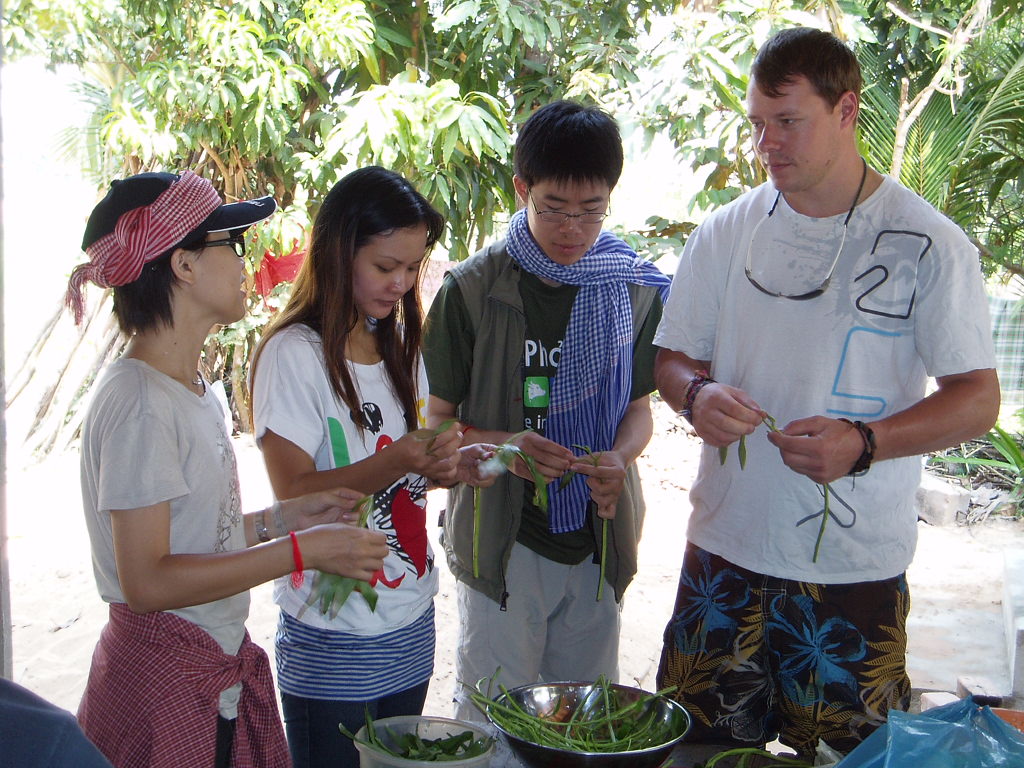
Angela from Vietnam, Theresa from Indonesia, Elliot from California and Adam from Texas

I spent last Monday out in the village for a cooking class put on for my CouchSurfing friends. Da and I had planned a pretty hefty menu of 4 courses including:
  • Fried Spring Rolls
  • Samlor Majou Groen (sour soup with beef and morning glory water spinach)
  • Beef Lok Lak
  • Pumpkin Custard
The steamed pumpkin custard. Yum!

Five Couch Surfers participated, though some were a bit more active than others. There was a lot of garlic that needed to be peeled! I hopped on that one right away.

Angela giving the beef a stir.

Da's brother Houy just so happened to be up visiting from Phnom Penh, so he helped with the explanation of things, too.

Houy helps out and keeps things organized!

We ended up eating the spring rolls after the soup and Lok Lak. I would have rather not used dried shrimp in the spring rolls, but that's what his mom decided to use.

Wrapping the spring rolls.

Here's a video link showing the beef Lok Lak being cooked.

What a fun day!

Saturday, February 05, 2011

Rubbing me the wrong way

Getting a massage in Cambodia is commonplace. Some even come with happy endings (at least ones that are offered to men). I generally don't get massages because I don't really like the idea of someone I don't know putting their hands all over me.

But, worse than that, I haven't really ever had a great massage.

I remember one time I got a massage where I felt worse coming out than when I went in. I felt like I was beaten and bruised during the whole ordeal.

I sincerely believe Cambodians don't really understand how to massage a foreigner. Either you're being pounded and stretched like you're on a medieval torture device, or they just push some skin around and snap your fingers.

Tonight I had another disappointing massage.

I was really expecting something better because it was a friend's place, and he had really talked it up as being great. In the end, nothing was really massaged. I just had some fat pushed around, not my shoulders and feet worked on like I was hoping.

Oh well, I guess I'll keep looking and hoping...

Tuesday, January 25, 2011

Another amazing organization in Siem Reap

I was first introduced to the young man who helps run the Khmer for Khmer Organization (KFKO) through a CouchSurfing contact. After arranging a meeting with Sokha, he introduced me to another friend from France, Raphael, who was helping out, too. I ended up making a plan to ride our bikes out to visit the village where KFKO does their work.


KFKO is truly doing what it's name implies. Cambodians are helping Cambodians. The young volunteers are using their own money, in addition to the occasional donations, to fund four major projects within the village.


KFKO focuses on Early Childhood Education, Nutrition for Mothers & Children, a Handicrafts project for HIV-positive women and an Agricultural project for growing vegetables to help out the nutrition program and villagers who participate.


Only founded in November 2010, these young folks have big dreams for this village.

Pancakes

Thank you to Mom Most Traveled, Can Can, for providing this recipe. I look forward to trying this out with a few modifications for here in Cambodia, such as substituting soy milk for rice milk, using regular oil, and adding bananas instead of blueberries and walnuts.

Ingredients

Wet Ingredients (have at room temperature):
2 eggs
1/4 cup rice milk
2 Tbsp oil (walnut, almond, grapeseed or corn)
1/2 tsp vanilla (optional)

Dry Ingredients (have at room temperature):
3/4 cup rice flour (or 1/2 cup rice flour and 1/4 cup corn flour)
3/4 tsp non-aluminum baking powder
1/2 tsp salt
1 or 2 Tbsp oil for frying (coconut or corn)
1/8-1/4 cup blueberries fresh or frozen
1/8 cup walnuts (optional)

Directions

Mix wet and dry ingredients separately, then combine. Be sure to have the griddle heating to a medium temperature. Blend in blueberries and walnuts if used. Makes about 5 five inch cakes. Smother in maple syrup.

If using fruit in the batter, covering the cakes when cooking helps ensure they will be done throughout. A little more baking powder makes for thicker, fluffier cakes, and a little less makes thinner more dense cakes.

Monday, January 24, 2011

Compassion in action

My first week of travels back to Southeast Asia in early December 2010, took me to Thailand. I spent a couple of days in Bangkok before heading up to Chiang Mai that would serve as my base for a 1-day visit to the north in Fang to visit the Compassion child I sponsor: Jairak Ja-U.
Our 1st meeting. Me holding the traditional bag his mother made for me.

I really didn't know what to expect since I had only just started sponsoring Jairak Ja-U a couple of months prior. The two other children I was sponsoring had both dropped out of the program within a month of each other, and Jairak was the recommended boy to replace them.

He couldn't have been a better match!

Posing in front of the "Christmas flowers" (Poinsettias).

The shyness was very evident, yet understandable. We exchanged gifts and asked a few questions (translated, of course) before getting a tour of the hostel where he is living. He seemed very happy to have met me. It was very special since many children don't ever get to meet their sponsors except through letters and photographs.

I think the best part of the trip was going to his high school to see his classroom and his best friends. It was a pleasure to be able to meet them and pray together before saying good bye.
Standing with his school mates & friends.

I will cherish that day, despite feeling a little under the weather in the morning. It was so adorable when we said goodbye as Jairak called out, "Good bye. See you tomorrow!" in English.

Precious.
Visiting the local hot springs in our matching hats (which we both like to wear).